Research Article | | Peer-Reviewed

Demographic Evolution in Extensive Cattle Breeding in the Urban Area of Abeche City, Chad

Received: 20 May 2026     Accepted: 2 June 2026     Published: 18 June 2026
Views:       Downloads:
Abstract

The objective of this study was to determine the Demographic evolution in extensive cattle breeding in the urban area of Abeche, Chad. This study was conducted using a cross-sectional survey and a single-visit observation, with a questionnaire administered to farmers after obtaining their consent. The study was conducted from November 1st to December 31st, 2024, and included 75 cattle farms, comprising 54 indigenous agrobreeders and 21 agropastoralists. The information sought included: the profile of livestock farmers, herd structure, mortality rates, exploitation rates, herding practices, types of cattle farming systems, and livestock feeding and health care practices. The collected data were analyzed using XLSTAT software (6.1.9). Cattle farming in Abeche city is owned by women educated at the Koranic school, of the Banihalba Arab ethnic group. The average herd size is 18.62 ± 1.20 head, all individually owned. Cattle are acquired primarily through inheritance and mainly for sale. Reproductive performance is acceptable, with a good fertility rate and a high juvenile mortality rate. Selling cattle was the main method of cattle farming, with a higher rate among agropastoralists. Bulls were the most heavily farmed animals. The growth rate was approximately 4%. High exploitation rates and juvenile mortality have negatively impacted herd growth. The numerical yield of the herds is approximately 22%. These results will allow for targeted livestock interventions to reduce juvenile mortality and, then improve herd numerical productivity. A demographic study in other localities would allow for an assessment of the local cattle population growth rate and for organizing support for farmers on improving husbandry practices and reproductive performance.

Published in Animal and Veterinary Sciences (Volume 14, Issue 3)
DOI 10.11648/j.avs.20261403.14
Page(s) 75-86
Creative Commons

This is an Open Access article, distributed under the terms of the Creative Commons Attribution 4.0 International License (http://creativecommons.org/licenses/by/4.0/), which permits unrestricted use, distribution and reproduction in any medium or format, provided the original work is properly cited.

Copyright

Copyright © The Author(s), 2026. Published by Science Publishing Group

Keywords

Cattle, Extensive Breeding, Growth, Numerical Yield, Abeche, Chad

1. Introduction
Livestock farming is one of the most important sectors of the economy in many African countries, particularly in the Sahel region . In some countries, it contributes nearly 40% to GDP and supports almost 80% of the population . As such, it is one of the main means of fighting rural poverty . Cattle constitute approximately 26.5% of the national livestock herd and are indeed the main livestock exported to neighboring countries, representing both a means of subsistence and a status symbol .
Chadian cattle herds are characterized by their great diversity of hardy breeds, raised primarily in extensive pastoral and agropastoral systems with highly variable herd sizes as an adaptation strategy to the effects of climate change . Chad has significant cattle production potential, with a herd estimated at over 24.9 million head . The animal population has seen a remarkable increase following health monitoring of herds .
Human population growth is driving strong demand for animal products. However, extensive Chadian cattle farms lack any means of monitoring animal performance . Consequently, assessing numerical productivity is not possible in these farms due to a lack of data on birth rates, weaning survival rates, juvenile and adult mortality, and farm mortality . Yet, these parameters are crucial for improving production through better husbandry practices . Therefore, having reliable indicators and tools to estimate the impact of interventions on herd productivity is essential .
Increasing the productivity of traditional ruminant herds is a key way to meet the growing demand for animal products in sub-Saharan African countries . In Burkina Faso indicates that demographic studies allow for the analysis of herd dynamics and the determination of herd growth. Therefore, this study is justified in Abeche city to understand the role of livestock herds in the face of the emergence of new types of livestock farming in peri-urban areas.
The objective of this study was to determine the Demographic evolution in extensive cattle Breeding in the urban area of Abeche, Chad.
2. Materials and Methods
2.1. Study Area
The study was conducted in Abeche city, capital of the Ouaddaï Province, located between 13° 48’584’’ North latitude and 20° 50’139’’ East longitude. The Abeche city of is located 900 km east of N’Djamena, the capital of Chad. The study area is under the influence of an intertropical climate with a dry season of 9 months (October to June) and a rainy season of 3 months (July to September). The weather patterns of these two seasons are defined by the fluctuations between dry air masses from the north (the Harmattan wind) and humid maritime air masses from the southwest (the monsoon).
The average annual rainfall is approximately 300 mm. The region's temperature varies throughout the year. The average annual temperature in Abeche is around 28°C, with variations between 16°C and 35°C during the cool season (December to February) and between 25°C and 41°C during the dry season (April and May). The city comprises six districts and several neighborhoods.
2.2. Materials
The study was conducted using a cross-sectional survey and single-visit observation with a questionnaire administered to 75 cattle farms in Abeche city. These herds were chosen randomly, and the farmers were selected based on their accessibility and availability to complete the questionnaires. A preliminary survey was conducted to test the survey forms in the field and to finalize the list of farmers to be surveyed.
2.3. Data Collection
After a pre-arranged appointment, the farmers were interviewed either in the morning or afternoon, depending on their availability. The survey was conducted with the entire herd present and with the farmers' consent.
The information sought focused on: the profile of livestock farmers, the structure and composition of herds, mortality rates, exploitation rates, growth rates of livestock management practices, types of cattle farming systems, and cattle feeding and health care practices. This will allow for the determination of the exploitation rate. The study focuses exclusively on cattle farming.
The main parameters selected for this study are as follows:
1) Livestock status variables: The average herd size, which is the average number of individuals comprising the herd; the structure by sex and age class (juvenile, subadult, and adult), which is the distribution of all animals according to sex. This is a relevant indicator for the study of demography;
2) Baseline and management demographic rates: Demographic events provide information on the farmer's decision-making processes, which quantify management. The demographic parameters include reproduction, mortality, and numerical exploitation.
2.4. Data Analysis
The collected data were analyzed using XLSTAT software (6.1.9). Descriptive analysis was used to determine the parameters of dispersion (mean ± standard deviation, extremes, and frequencies), and analysis of variance (ANOVA) was performed to compare the means. The parameters studied were: herd size (initial and current numbers), herd size and structure (sexes and categories), calving rate, mortality rate, exploitation rate, and growth rate. The comparison of means was performed using the Newman-Keuls test at the 5% significance level.
2.5. Ethical Consideration
This study was conducted without any manipulation of the cattle or their products. Our presence on the farms was solely for the purpose of interviewing farmers and photographing the animals within the herds. This was not associated with any risk to the physical or health of the cattle or consumers of their products (milk and meat).
3. Results
3.1. Sociodemographic Profile of Cattle Breeders in Abeche City
The breeders have 42.11 ± 0.86 years (28 to 60 years) of old, and 6.22 ± 0.25 children (3-11). The cattle breeders in Abeche city are relatively young, having six children.
The herder profile is presented in Table 1.
Table 1. Sociodemographic Profile of Cattle Farmers in Abeche City.

Parameter

Variable

Effective (n)

(%)

Sex

Male

28

37.33

Female

47

62.67

Ethnic Group

Banihalba

29

38.67

Kouchta

2

2.67

Mahamit

18

24.00

Maharie

1

1.33

Masirie

12

16.00

Woulat malik

3

4.00

Woulat rachid

10

13.33

Schooling

No

32

42.67

Yes

43

57.33

Schooling Level

Quranic

26

60.47

Primary

17

39.53

Marital Status

Single

6

8.00

Married

58

77.33

Widowed

11

14.67

Activities

Trade

12

46.15

Breeding

6

23.08

Agriculture - Breeding

4

15.38

Others

4

15.38

The Banihalba ethnic group was the most represented, compared to other ethnic groups. Most of the breeders were married women of Muslim faith with a Quranic school level of education followed by primary school.
3.2. Herd Condition Variables on Cattle Farms in Abeche City
The average size of the herds is 18.62 ± 1.20 heads with a larger number (25.52 heads) among agropastoralists for a minimum number (13.87 heads) among agrobreeders (p<0.05).
The structure of these herds is described in Table 2.
Table 2. Structure of Herds According to Sex and Category of Cattle.

Parameter

Variable

Minimum

Mean ± SD

Maximum

Sex

Male

5.00

10.94 ±0.41b

20.00

Female

80.00

89.06 ±0.42a

95.00

Category

Juvenile

0.00

21.46 ± 0.71c

37.93

Subadult

29.41

45.12 ± 1.24a

80.00

Adult

37.93

33.42 ± 1.10b

50.00

Different letters indicate a significant difference (p < 0.05).
The proportion of females is higher and that of males is lower. This difference is significant (p<0.05). Depending on the categories, the proportion of subadults was the highest. It is followed by that of adults. Juveniles had the lowest proportion (p<0.05).
3.3. Mode of Acquisition, Ownership and Objective of the Farms Surveyed
The management of cattle herds and method of acquisition are presented in Table 3.
Table 3. Breeding Objective and Mode of Acquisition of Cattle in Abeche City in Chad.

Parameter

Variable

Number (n)

Percentage (%)

Breeding objective

Sale

75

100.00

Purchase of animals

No

75

100.00

Acquisition mode

Donation

7

9.33

Legacy

47

62.67

Wedding

20

26.67

Herd Property

Collective

12

16.00

Individual

63

84.00

Animal Products

Consumption

14

18.67

Sale

61

81.33

All breeders hold cattle for sale. These herds are essentially made up of inheritance or dowry from daughters. Individual ownership of herds dominated collective ownership. Cattle products are sold more than consumed for own consumption.
3.4. Cattle Rearing Practices in Abeche, Chad
Rearing practices are presented in Table 4.
Table 4. Cattle Rearing Practices in Abeche, Chad.

Parameter

Variable

Number (n)

Percentage (%)

Breed

Arabe Zebu

75

100.00

Breeding System

Sedentary

54

72.00

Transhumant

21

28.00

Cattle Feed Base

Natural route

75

100.00

Health Monitoring

No

28

37.33

Yes

47

62.67

Monitoring Type

Deworming

16

34.04

Vaccination

31

65.96

The Arab Zebu is the only breed of cattle raised in Abeche in a predominantly sedentary breeding system whose basis of diet is the natural range. More than half of the breeders ensure health monitoring through vaccination against the main diseases.
3.5. Basic Demographic Rates and Management of Cattle Herds in Abeche City, Chad
3.5.1. Reproduction Performances of Cattle Herds in Abeche City, Chad
Indicators of cow reproduction are presented in Table 5.
Table 5. Cow Reproduction Parameters and Juvenile Mortality.

Parameter

Minimum

Mean ± SD

Maximum

Age at 1st Calving (year)

4.00

4.31 ± 0.05

4.50

Calving Intervals (year)

2.00

2.18 ± 0.05

2.00

Fertility Rate (%)

25.81

85.06 ± 1.86

100.00

Calving Rate (%)

33.33

66.99 ± 2.04

100.00

Abortion Rate (%)

5.00

16.60 ± 0.94

41.26

Calf Mortality Rate (%)

0.00

38.92 ± 4.01%

100.00

The first calving is quite late with a calving-calving interval, more than 2 years. The fertility rate is satisfactory, the calving rate is relatively good. Abortion and calf mortality rates are worrying.
Certain reproductive parameters and juvenile mortality varied depending on the type of breeder (Table 6).
Table 6. Variation in Rates of Calving, Abortion and Juvenile Mortality in Cattle Herds Depending on the Type of Breeders Surveyed.

Type of Breeder

Calving Rate (%)

Abortion Rate (%)

Juvenile Mortality Rate (%)

Agro-breeder

65.10a

14.96b

32.69a

Agropastoralist

71.83a

20.79a

40.24a

Different letters indicate a significant difference (p < 0.05).
The calving rate and that of juvenile mortality seem to be higher in the herds of agropastoralists than in the agrobreeders but this difference is not significant (p > 0.05). The highest abortion rate is recorded in agropastoralists (p < 0.05).
3.5.2. Exploitation Parameters of Cattle Herds in Abeche City
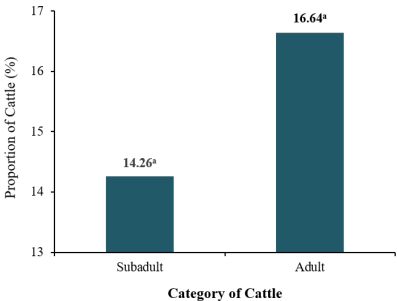
Exploitation rate was 17.11 ± 0.88% with 98.67% exploitation of males and 1.33% of females. The commercial exploitation rate represented 16.39 ± 0.84% of the overall exploitation rate with a minimum of 5% and a maximum of 45.71%. This commercial exploitation varied depending on the categories of cattle sold (Figure 1).
Figure 1. Variation in the Proportion of Cattle Sold by Category.
Adults are the most sold and sub-adults are the least sold. This difference is not significant at the 5% threshold.
3.5.3. Growth Parameters of Cattle Herds in Abeche City, Chad
The parameters which define the demographic evolution of cattle herds in Abeche in Chad are presented in Table 7.
Table 7. Parameters of Demographic Evolution of Herds in Abeche City, Chad.

Parameter

Minimum

Mean ± SD

Maximum

Gross Growth Rate (%)

-66.66

4.46 ± 2.41

33.33

Net Growth Rate (%)

-66.66

4.46 ± 2.41

33.33

Exploitation Rate (%)

4.25

17.11 ± 0.88

43.24

Numerical Yield (%)

-38.09

21.57 ± 2.08

54.05

The different gross and net growth rates are almost similar in the two types of livestock farming in the study area. The exploitation rate is quite high. The numerical yield of the cattle herd is positive.
These parameters varied depending on the types of breeders (Table 8).
Table 8. Rate of Demographic Change According to the Different Types of Cattle Breeding in Abeche City.

Parameter

Agropastoralist

Agrobreeder

Mean ± SD

Starting Herd Size (n)

17.13a

14.00b

17.13 ± 0.91

Actual Herd Size (n)

18.63a

13.50b

18.62 ± 1.20

Average Herd Size (n)

17.88a

13.50b

17.88 ± 1.04

Exploitation rate (%)

43.24a

4.26b

17.11 ± 0.88

Gross Growth Rate (%)

-66.67a

-33.33a

4.46 ± 2.41

Net Growth Rate (%)

-66.67a

-33.33a

4.46 ± 2.41

Numerical Yield (%)

-38.10a

54.05b

21.57 ± 2.08

Different letters between columns indicate a significant difference at the 5% threshold.
The growth rate is negative for both types of breeders (p ˃ 0.05). Agropastoralists exploited cattle more than agro-breeders (p < 0.05). Growth rates are negative for both types of breeders. The numerical yield is good among agro-breeders and negative among agropastoralists (p < 0.05).
4. Discussion
4.1. Profile of Cattle Breeders in Abeche City
The study results revealed that cattle farmers in Abeche city are all Muslim. The predominance of Muslim farmers is explained by the fact that the area is predominantly Muslim. The majority of farmers are female (62.67%). This difference is explained by the fact that women have significantly more opportunities to acquire cattle. According to Arab tradition, parents give a cow and a calf to their married daughter. Thus, these gifts of cattle from their parents form the core of their initial herd. It is worth noting that this observation is unusual because cattle farming is generally a male activity. This proportion is higher than the 1.70% of female farmers reported in Mandoul, Chad .
The majority of herders are married (77.33%), with a minority (14.67%) being widows (or widowers) and single (11%). Marriage entails family responsibilities that must be met. Therefore, livestock farming is an activity that can effectively fulfill this role by providing a means of subsistence for herding families. These figures are higher than the 95% of married herders reported in Niger (Niamey) and lower than the 52.5% reported in Chad . According to the ethnic group of the herders surveyed, the Banihalba were the most represented (38.67%), compared to other ethnic groups such as the Mahamits (24%) and the Masirie (16%). The high proportion of herders of Banihalba ethnic group (Arabs) is due to the fact that they are the oldest indigenous inhabitants of Abeche city and have a pastoral tradition.
The proportion of educated herders was the majority (57.33%), with the majority having attended Quranic school, while a minority of 42.67% were uneducated. Those who had attended Koranic school represented 60.47%, compared to a minority of 39.53% who had attended formal primary school. The high proportion of educated herders is explained by the presence of schools in the study area and could be an asset in training herders to adopt modern techniques in order to improve livestock production. The school enrollment rate is higher than that obtained in West Africa of which uneducated herders represented 43% and those with a formal primary school education 10%.
The average family size for herders in the study area was 8 people with 6.22 ± 0.86 children. The large family size could be explained by the need for a large workforce in this activity. Young boys are responsible for herding the animals to pasture, women for milking and selling the milk, while the men are involved in other activities (farming or trade). This number of children per family is lower than that reported in Burkina Faso who found an average of 8 children per household in the peri-urban area of Bobo-Dioulasso. However, it is not significantly different from that reported in Senegal . The livestock farmers in the study area have an average age of 42.11 ± 0.86 years. They are relatively young. It would be difficult for these self-employed farmers to own a sizable cattle herd (due to the high acquisition cost) unless they inherited it. These results are consistent with those in West Africa , and particularly with those in Mali .
4.2. Herd Status Variables in Cattle Farms in Abeche City
The average herd size is 18.62 ± 1.20 head, with a larger herd size (25.52 head) among agropastoralists and a smaller one (13.87 head) among agrobreeders. The larger herd size recorded among agropastoralists is linked to the mobility of transhumant herds. Indeed, pastoralists are more interested in larger herd sizes than sedentary livestock farmers. This cattle herd size is smaller than the herd size reported in the peri-urban area of Bobo-Dioulasso , where the average herd size is 70 head in traditional farms.
The proportion of females (89.06%) is higher than that of males (10.94%). This indicates the productive potential of the surveyed herds, as the large proportion of females (breeding cows and heifers) would determine the profitability of livestock farming. However, this proportion of females recorded in the surveyed herds is lower than 63% of females in traditional farming systems . Depending on the category, the proportion of subadults was higher than that of adults and juveniles. Juveniles represented 21.46% of the herd size. This proportion reflects reproductive performance and is a good indicator of population trends. However, this rate is higher than the 4% reported in Burkina Faso and obtained in Mali . Furthermore, this result is slightly higher than the 19% reported in agro-pastoral and agrobreeding areas of northern Benin in the Ferlo region of Senegal , in Zaria, in Nigeria , and in northern Benin .
4.3. Acquisition Method, Ownership, and Purpose of the Surveyed Herds
The herds are largely comprised of inherited cattle (62.67%) and cattle given as dowries for daughters in marriage (26.67%). However, 9.33% of the cattle were acquired as gifts from parents to their married daughters. This is linked to Arab tradition and the traditional cattle breeding practices that favor married daughters. These results differ from those reported in northern Côte d'Ivoire , where the acquisition methods varied: 49% by purchase, 20% by inheritance, 4% by donation, and 27% by combined methods.
In the surveyed farms, the majority of herds were individually owned (84%), while collective herds represented only 16%. This difference in proportions is explained by the fact that collective herds always originate from paternal inheritance. This observation corroborates the findings reported in Côte d'Ivoire where 85% of herds were individually owned.
In the study area, cattle are raised exclusively for sale. This indicates that livestock farming constitutes the main source of income for these farmers. Animal products (milk and butter) are also more frequently sold (81.33%) than consumed (18.67%). Therefore, cattle farming represents a form of insurance, not only in the fight against poverty but also as the main source of social security and livelihoods for livestock farmers. These results are higher than those obtained in Mali where 34.55% of cattle are raised for sale and 10.07% for consumption in agropastoral herds. Furthermore, the rate of livestock sales far exceeds the 5% reported in transhumant herds in Mauritania , and particularly in Mali, where the average age of livestock farmers in peri-urban areas is 42 ± 0.8 years.
4.4. Cattle Breeding Practices
The cattle's basic diet consisted exclusively of natural pasture. In the extensive breeding system, cattle are taken to pasture daily, primarily by a member of the breeder's family. This proportion (100%) is higher than 80% reported in Burkina Faso and 98% in Chad , indicating that breeders utilize natural pasture.
Breeders who monitor their herds' health by vaccinating their animals against major diseases represented 65.96%, while those who do so through deworming represented 34.04%. These results indicate that livestock health monitoring in extensive farming systems is inconsistent and not well-established. The vaccination rate is lower than that reported in Benin where 90% of livestock were vaccinated. This finding is consistent with that observed in Italy the Sahel , and Benin . The cattle breeds found in the study area were Arab Zebu. The predominance of Arab Zebu in the study area is due to the breed's adaptation to the local climatic conditions. Similar observations regarding the adaptation of animal breeds to their breeding area were reported in Burkina Faso where Fulani Zebu are dominant in the various sites (study area). This result is higher than that reported in northern Benin including 80.14% Fulani Zebu cattle in traditional cattle herds.
4.5. Baseline Population and Cattle Herd Management Rates in Abeche City
4.5.1. Reproduction Performances and Juvenile Mortality
The reproductive performance of the herds was generally low, with heifers over 4 years old at first calving and calving intervals exceeding 24 months. This poor reproductive performance is certainly linked to underfeeding and uncontrolled health problems in extensive farming. These results are lower than those in Chad , where the calving interval was 63.88 months, but higher than that reported where the calving interval for Arab cows was 16.34 months in peri-urban cattle farms of N'Djamena (Chad) . The average fertility rate was 85.06%. This proportion is explained by the fact that reproduction is uncontrolled and breeding is unrestricted. This result is lower than the 83% reported in Ivory Coast in the N'Dama and Baoule breeds. The majority of the females surveyed are approximately 4.5 years old. The age at which they reach their productive potential. These results are consistent with those reported in the Sahel , whose average age for heifers was 4 years. The calving rate was 66.99 ± 2.04%. This rate is very satisfactory. However, juvenile mortality in the herd was very high (38.92 ± 4.01%). This calf mortality seriously hinders population growth, as animal reproduction and health are fundamental to herd productivity. This high mortality rate in Sahelian pastoral farming systems is often linked to insufficient forage availability and inadequate health monitoring. Nutritional deficiencies, especially during the dry season, and parasitism during the rainy season also contribute. The most frequently cited cause of mortality by farmers was forage deficiency. This result is higher than that obtained in Niger whose juvenile mortality rate was 0.11 ± 0.01%, and in the Sahel whose young mortality rate was 2.87 ± 0.19%. This finding is consistent with our results.
4.5.2. Cattle Herd Management Rates in Abeche City
The exploitation rate was 17.11 ± 0.88%, with 98.67% of the herd being males and 1.33% females. The overall exploitation rate is higher than 4,8 à 5,1% reported in Benin . Similar observations regarding the variation in the proportions of cattle exploited according to sex were made in the Sikassa zone of Mali , and in Niger, where females and heifers are kept for breeding . The commercial exploitation rate represented 16.39 ± 0.84% of the overall exploitation rate, with a minimum of 5% and a maximum of 45.71%. This excessive commercial exploitation reflects the dependence of agropastoral families on livestock for their survival. All herders exploit male cattle, with 16.64% being adults and 14.26% subadults. Adults are sold more frequently than subadults. This is done to generate substantial income from the sale of a single head and to meet the family's basic needs. These figures are lower than the 43% of adult cattle sold in Benin , and the 39% in the Sahel region . The exploitation rate of 98.67% of males is significantly higher than the 9% of males sold in Senegal and the 11% of males sold in Algeria . The exploitation rate is less than the estimated 12% in pastoral livestock farming in Burkina Faso . This rate is not very different from 17.01 ± 0.81% obtained in traditional livestock farming in the Sikasso zone of Mali , 17% in northern Benin and the Ferlo zone of Senegal , and 16% in Benin .
4.5.3. Population Growth of the Surveyed Cattle Herds
The average growth rate is 4.46 ± 2.41%. This is positive, although low, whereas a negative growth rate (-20.50 ± 2.94%) was reported in cattle herds in southern Chad . The low growth rate is due to traditional farming practices in the Sahel. A similar rate of 4.14 ± 2.06% was reported in Mali . However, this rate is lower than the 95% reported for intensive livestock farming in Burkina Faso . Herd growth is very slow due to the extensive nature of the farming system. The study of the variation in this growth rate between different types of farmers indicates that it is negative for both. This is linked to the level of cattle exploitation and the high rate of juvenile mortality. The net yield of the surveyed farms is 22%. This yield is quite good for extensive farming. This result is higher than the 3% reported in Mali . Agropastoralists have exploited cattle more than agrobreeders. This explains why the numerical yield in the herds of agropastoralists is negative, while that of the herds of agrobreeders is better.
5. Conclusions
This study was conducted to determine the demographic evolution of extensive cattle herds in the Abeche city. The study reveals that cattle farming is held by two ethnic groups of herders: the Banihalba Arabs (indigenous) practicing the agro-pastoral system, and settled agro-pastoralists of other ethnic groups operating within the agro-pastoral system. The average herd size is 18.62 ± 1.20 head, all individually owned. Cattle are acquired primarily through inheritance and mainly for sale. Reproductive performance is acceptable, with a good fertility rate and a high juvenile mortality rate. Sale was the primary method of cattle exploitation, with a higher rate among agropastoralists. Bulls were the most affected by the management practices. The growth rate was positive, at approximately 4%. High exploitation rates and juvenile mortality negatively impacted herd growth. The numerical yield of the herds was approximately 22%. These results will allow for targeted livestock management interventions to reduce juvenile mortality and improve herd productivity. A demographic study in other localities would allow for an assessment of the local cattle population growth rate and for organizing support for farmers on improving husbandry practices and reproductive performance.
Abbreviations

GDP

Gross Domestic Product

SD

Standard Deviation

Author Contributions
Madjina Tellah: Conceptualization, Resources, Supervision, Formal Analysis, Writing – original draft, Writing – review & editing
Zenaba Mahamat Adoum: Investigations, Resources, Methodology, Writing – original draft
Koumaoudjeng Doulgue: Data curation, Supervision
Hassan Kedere Honore: Investigations, Data curation, Methodology
Data Availability Statement
The data is available from the corresponding author upon reasonable request.
Conflicts of Interest
The author declares no conflicts of interest.
References
[1] Ministère des Ressources Animales (MRA). Politique nationale de développement durable de l’élevage au Burkina Faso 2010-2025. MRA, 2010, 54 p.
[2] Kassa, K. S., Ahounou, S., Dayo, G. K., Salifou, C., Issifou, M. T., Dotche, I., Gandonou, P. S., Yapi-G. V., Koutinhouin, B., Mensah, G. A., Youssao, I. A. K. Performances de production laitière et structure des races bovines de l’Afrique de l’Ouest. Int. J. Biol. Chem. Sci., 2016, 10(5), 2316-2330.
[3] CEDEAO (ECOWAS), Formulation et mise en œuvre d’un Programme Régional d’Investissement Agricole (PRIA), Composante: « aménagements pastoraux et organisation de la transhumance transfrontalière », volume 2, sous-programme gestion améliorée des autres ressources naturelles partagées. Septembre 2009, version finale, 58 p.
[4] Organisation des Nations pour l’Alimentation et l’Agriculture (FAO). Division des statistiques sur l’élevage au Tchad, 2020, 48 p.
[5] Lesnoff M. Méthodes d’enquête pour l’estimation des taux démographiques des cheptels de ruminants domestiques tropicaux. Synthèse, limites et perspectives. Revue d’élevage et de médecine vétérinaire des pays tropicaux, 2013, 66(2), 57-67.
[6] Kagoné, H. Profil fourrager et structure des élevages du Burkina Faso. FAO, 2001, 23 p.
[7] Ministère de l’Elevage et des Productions Animales (MEPA). Recensement général de l’Elevage : Principaux résultats., Tchad, 2018, 47 p.
[8] Ministère d’Elevage (ME). Atlas sur l’élevage au Niger: L’élevage au Niger, une richesse sans fin. Direction des statistiques, Ministère de l’élevage, Niamey, Niger, 2014, 133 p.
[9] Ministère de l’Elevage et des Productions Animales (MEPA), 2016. Plan National de Développement du Tchad (PNDE), Tchad, 2009-2016, 2008, 82 p.
[10] Moulin, C. Demographic dynamics and off-take of cattle herds in south Mali. Tropical Animal Health and Production, 2011, 43, 1101-1109.
[11] Savadogo, K., Inoussa, C. Etude des paramètres démographiques du cheptel bovin des élevages périurbains de la ville de Bobo-Dioulasso. Université Polytechnique de Bobo-Dioulasso, 2017, 71 p.
[12] Baïzina, M., Tellah, M., Assadi, M., Odjigue, N., Mopaté, L. Y. Structure, composition des troupeaux et conduite de la reproduction des systèmes d’élevage bovin de la Province de Mandoul au Tchad, Journal of Applied Biosciences, 2022, 181, 18901-18916,
[13] Chaibo, M., Illia, A. S., Marichatou, H. Pratiques de gestion et performances de production dans les élaves bovins laitiers urbains et péri-urbains de Niamey. Revue des Bioressources, 2011, 1(2), 1-12.
[14] Touré O. Pastoralisme et développement durable en Afrique de l’ouest: deux vieux compagnons de route, 2017, 90 p.
[15] Jorat, T. Simulations de dynamiques de cheptels bovins après une sècheresse au sahel en fonction des types d’exploitation pastorales: cas du Ferlo au Sénégal. Rapport de Master BGAE-Sciences pour l’environnement, CIRAD-ILRI Université Montpellier II, 2011, 60 p.
[16] Coulibaly, D. Changements sociotechniques dans les systèmes de production laitière et commercialisation du lait en zone péri-urbaine de Sikasso, Mali. Thèse de Doctorat de l’Institut des Sciences et Industries du vivant et de l’Environnement (Agro Paris Tech) discipline Zootechnie des systèmes d’élevage, Ecole doctorale Institut National Agronomique Paris-Grignon, 2007, 392 p.
[17] Adanléhoussi, A., Hamadou, S., Hamani, M., Kamuanga, M., Salissou, I., Sangaré, M. I., Tamboura, H. H. Caractérisation des systèmes de production laitière en zone CIRDES. In: Rapport final PROCORDEL, CIRDES-ILRI, Bobo-Dioulasso, Burkina Faso, 2005, 94 p,
[18] Zampaligre, N., Savadogo, I., Sangare, M. Analyses des paramètres démographiques et zootechniques du cheptel bovin des élevages péri-urbains laitiers de la ville de Bobo-Dioulasso à l’Ouest du Burkina Faso. Int. J. Biol. Chem. Sci. 2019, 13(1), 442-451.
[19] Ba, A., Lesnof, M., Coulibaly, D., Chapuis-Poccard, R., Moulin, C. Demographic dynamics and off-take of cattle herds in southern Mali. Trop Anim Health Prod, 2011, 43, 1101–1109.
[20] Dehoux, J. P., Hounsou-Ve, G. Productivité de la race bovine Borgou selon les systèmes d'élevage traditionnels au nord-Est du Bénin, 1993, 18 p.
[21] Akpa, G. N., Alphonsus, C., Abdulkareem A. Evaluation of herd structure of white Fulani cattle holdings in Zaria-Nigeria. Scientific Research and Essays, 2012, 7(42), 3605-3608.
[22] Toko, R. C., Adégbidi, A., Lebailly, P. Démographie et performances zootechniques des élevages bovins traditionnels au Nord Bénin. Revue d’élevage et de médecine vétérinaire des pays tropicaux, 2016, 69(1), 33-39.
[23] Bosson, A. N., Fatoumata, C., Nahoulé, S., and Gboko, B. G. K. Constraints to the Development of Sedentary Cattle Farming in the District of Denguele, in the North-West of Cote d’ivoire. Multidisciplinary International Journal of Research and Development, 2022, 2 (1): 23-32.
[24] Soro D. P. Sokouri G. K., Dayo A. S. P., N’Guetta C. V., Yapi-Gnaoré, C. V. Caractérisation des bovins de race Baoulé dans le ''Pays Lobi" de Côte d'Ivoire: rôles socioéconomiques, modes d'élevage et contraintes de production. Tropicultura, 2015, 33 (2), 111-124.
[25] Ba, A., Lesnoff, M., Chapuis-Poccard, R., Corniaux, C., Moulin, C. H. Évaluation du potentiel exploitable du cheptel de bovins dans la zone cotonnière du Mali. 16ème journées Rencontres Recherches Ruminants, 2009, 385 p.
[26] Dicko, M. S., Djiteye, M. A., Sangare, M. Les systèmes de productions animales au Sahel. Revue Sécheresse, 2006, 17(1), 83-97.
[27] Duteurtre, G., Kamil, H., Le Masson, A. Etudes sur les sociétés pastorales au Tchad. Rapport de synthèse, CIRAD-EMVT, 2002, 80 p.
[28] Youssao, A. K. I., Ahissou, A., Touré, Z., Leroy, P. L. Productivité de la race Borgou à la Ferme d’élevage de l’Okpara au Bénin. Revue d’élevage et de médecine vétérinaire des pays tropicaux, 2000, 53 (1), 67-74.
[29] Otte, M. J., Chilonda, P. Cattle and small ruminant production systems in sub-Saharan Africa: a systematic review. Livestock Information Sector Analysis and Policy Branch, FAO Agriculture Department, Rome, Italy, 2002, 98 p.
[30] Corniaux, C., Thebaud, B., Gautier D. La mobilité commerciale du bétail entre le Sahel et les pays côtiers: l’avenir du convoyage à pied. Nomadic Peoples, 2012, 16(2), 5-31.
[31] Youssao, I., Dahouda, M., Attakpa, E., Koutinhouin, G. B., Ahounou, G., Toleba, S. S, Balogoun, B. S. Diversité des systèmes d'élevages de bovins de race bovine Borgou dans la zone soudanienne du Bénin. Int. J. Biol. Chem. Sci, 2013, 7(1), 125-146.
[32] Zeuh V., 2000. Caractérisation génétique des ruminants domestiques et inventaires des ressources végétales. Laboratoire de Recherches Vétérinaires et Zootechniques de Farcha, N’Djaména, Tchad, 27 p.
[33] Tellah, M., Mbaindingatoloum, F. M., Mopate, L. Y., Boly, H. Age au premier vêlage et intervalle entre vêlages de quatre races bovines en zone périurbaine de N’Djamena, Tchad. Afrique Science, 2015, 11, 229-240.
[34] Diawara, M. O., Hiernaux, P., Mougin, E., Gangneron, F., Soumaguel, N., Viabilité de l’élevage pastoral au Sahel: Etude de quelques paramètres démographiques des élevages de Hombori (Mali). Cah. Agric. 2017, 26: 45006,
[35] Messad, S., Saley, M. Appui au projet PASEP, analyse des données de l’enquête démographique du cheptel de ruminants domestiques de la région de Tahoua (Niger). Rapport de mission, Ministère de l’élevage, Niamey, Niger, 2011, 60 p.
[36] Hessa, C. C., Sanni Worogo, S. H., Assani Seidou, A., Idrissou Y., Zorobouragui, L., Alkoiret Traore I., Démographie bovine des exploitations d’élevage sylvopastorales et agrosylvopastorales en situation d’adaptation au changement climatique au Bénin, Afrique SCIENCE, 2023, 22(6): 57 - 65 57,
[37] Fatna, B. Diagnostic de la situation de l’élevage bovin dans la région d’ElMenia. Mémoire de fin d’études, Université Kasdi Merbah, Ouargla, 2021, 107 p.
Cite This Article
  • APA Style

    Tellah, M., Adoum, Z. M., Doulgue, K., Honore, H. K. (2026). Demographic Evolution in Extensive Cattle Breeding in the Urban Area of Abeche City, Chad. Animal and Veterinary Sciences, 14(3), 75-86. https://doi.org/10.11648/j.avs.20261403.14

    Copy | Download

    ACS Style

    Tellah, M.; Adoum, Z. M.; Doulgue, K.; Honore, H. K. Demographic Evolution in Extensive Cattle Breeding in the Urban Area of Abeche City, Chad. Anim. Vet. Sci. 2026, 14(3), 75-86. doi: 10.11648/j.avs.20261403.14

    Copy | Download

    AMA Style

    Tellah M, Adoum ZM, Doulgue K, Honore HK. Demographic Evolution in Extensive Cattle Breeding in the Urban Area of Abeche City, Chad. Anim Vet Sci. 2026;14(3):75-86. doi: 10.11648/j.avs.20261403.14

    Copy | Download

  • @article{10.11648/j.avs.20261403.14,
      author = {Madjina Tellah and Zenaba Mahamat Adoum and Koumaoudjeng Doulgue and Hassan Kedere Honore},
      title = {Demographic Evolution in Extensive Cattle Breeding in the Urban Area of Abeche City, Chad},
      journal = {Animal and Veterinary Sciences},
      volume = {14},
      number = {3},
      pages = {75-86},
      doi = {10.11648/j.avs.20261403.14},
      url = {https://doi.org/10.11648/j.avs.20261403.14},
      eprint = {https://article.sciencepublishinggroup.com/pdf/10.11648.j.avs.20261403.14},
      abstract = {The objective of this study was to determine the Demographic evolution in extensive cattle breeding in the urban area of Abeche, Chad. This study was conducted using a cross-sectional survey and a single-visit observation, with a questionnaire administered to farmers after obtaining their consent. The study was conducted from November 1st to December 31st, 2024, and included 75 cattle farms, comprising 54 indigenous agrobreeders and 21 agropastoralists. The information sought included: the profile of livestock farmers, herd structure, mortality rates, exploitation rates, herding practices, types of cattle farming systems, and livestock feeding and health care practices. The collected data were analyzed using XLSTAT software (6.1.9). Cattle farming in Abeche city is owned by women educated at the Koranic school, of the Banihalba Arab ethnic group. The average herd size is 18.62 ± 1.20 head, all individually owned. Cattle are acquired primarily through inheritance and mainly for sale. Reproductive performance is acceptable, with a good fertility rate and a high juvenile mortality rate. Selling cattle was the main method of cattle farming, with a higher rate among agropastoralists. Bulls were the most heavily farmed animals. The growth rate was approximately 4%. High exploitation rates and juvenile mortality have negatively impacted herd growth. The numerical yield of the herds is approximately 22%. These results will allow for targeted livestock interventions to reduce juvenile mortality and, then improve herd numerical productivity. A demographic study in other localities would allow for an assessment of the local cattle population growth rate and for organizing support for farmers on improving husbandry practices and reproductive performance.},
     year = {2026}
    }
    

    Copy | Download

  • TY  - JOUR
    T1  - Demographic Evolution in Extensive Cattle Breeding in the Urban Area of Abeche City, Chad
    AU  - Madjina Tellah
    AU  - Zenaba Mahamat Adoum
    AU  - Koumaoudjeng Doulgue
    AU  - Hassan Kedere Honore
    Y1  - 2026/06/18
    PY  - 2026
    N1  - https://doi.org/10.11648/j.avs.20261403.14
    DO  - 10.11648/j.avs.20261403.14
    T2  - Animal and Veterinary Sciences
    JF  - Animal and Veterinary Sciences
    JO  - Animal and Veterinary Sciences
    SP  - 75
    EP  - 86
    PB  - Science Publishing Group
    SN  - 2328-5850
    UR  - https://doi.org/10.11648/j.avs.20261403.14
    AB  - The objective of this study was to determine the Demographic evolution in extensive cattle breeding in the urban area of Abeche, Chad. This study was conducted using a cross-sectional survey and a single-visit observation, with a questionnaire administered to farmers after obtaining their consent. The study was conducted from November 1st to December 31st, 2024, and included 75 cattle farms, comprising 54 indigenous agrobreeders and 21 agropastoralists. The information sought included: the profile of livestock farmers, herd structure, mortality rates, exploitation rates, herding practices, types of cattle farming systems, and livestock feeding and health care practices. The collected data were analyzed using XLSTAT software (6.1.9). Cattle farming in Abeche city is owned by women educated at the Koranic school, of the Banihalba Arab ethnic group. The average herd size is 18.62 ± 1.20 head, all individually owned. Cattle are acquired primarily through inheritance and mainly for sale. Reproductive performance is acceptable, with a good fertility rate and a high juvenile mortality rate. Selling cattle was the main method of cattle farming, with a higher rate among agropastoralists. Bulls were the most heavily farmed animals. The growth rate was approximately 4%. High exploitation rates and juvenile mortality have negatively impacted herd growth. The numerical yield of the herds is approximately 22%. These results will allow for targeted livestock interventions to reduce juvenile mortality and, then improve herd numerical productivity. A demographic study in other localities would allow for an assessment of the local cattle population growth rate and for organizing support for farmers on improving husbandry practices and reproductive performance.
    VL  - 14
    IS  - 3
    ER  - 

    Copy | Download

Author Information
  • Department of Breeding Sciences and Techniques, Higher National Institute of Sciences and Techniques of Abeche, Abeche, Chad

    Biography: Madjina Tellah is an Associate Professor at Higher National Institute of Sciences and Techniques of Abeche, Chad, Animal Breeding Sciences and Techniques Department. He completed his PhD in Animal Genetics and Reproduction from Polytechnique University of Bobo-Dioulasso, Burkina Faso in 2016, and his Master of Engineering in Animal Productions (Biotechnologies of Animal reproduction) from Higher National Institute of Sciences and Techniques of Abeche, Chad in 2008. He has supervised doctoral theses, master's theses, and bachelor's theses, resulting in the publication of several scientific articles and presentations at national and international conferences. Finally, he is a reviewer for journal articles and chairs panels at scientific conferences.

    Research Fields: Animal Reproduction, Breeding System, Animal Genetics, Animal Demography, Animal Production, Socioeconomics of Animal Productions.

  • Department of Breeding Sciences and Techniques, Higher National Institute of Sciences and Techniques of Abeche, Abeche, Chad

    Biography: Zenaba Mahamat Adoum completed her Master degree in Animal Productions from Higher National Institute of Sciences, and Techniques of Abeche, Chad in 2025. Her master's research focused on bovine demography and she is interested in research on Demography and Animal Productions. She is passionate about obtaining her doctorate degree, which is why she would like to be introduced to research.

    Research Fields: Demography and Animal Productions.
  • Department of Biology, University of N'Djamena, N'Djamena, Chad

    Biography: Koumaoudjeng Doulgue is a PhD Student in Animal Productions from the University of N’Djamena, Chad since 2023. He completed his Msc in Pastoralism in 2020 from AGRHYMET in Niger. He had few articles and oral communications on: the Animal system breeding, the Animal Demography, and the Pastoral resources. He is an assistant at the National School of Livestock techniques of N'Djamena. He is still in his early stages of scientific research but very committed to pursuing a career in research.

    Research Fields: Animal system breeding, Animal Demography, and Pastoral resources.

  • Department of Breeding Sciences and Techniques, Higher National Institute of Sciences and Techniques of Abeche, Abeche, Chad

    Biography: Hassan Kedere Honore completed his Master degree in Animal Productions from Higher National Institute of Sciences and Techniques of Abeche, Chad in 2025. He is interested by research in Genetics characterization of local goat breed. He is passionate about obtaining his doctorate degree, which is why she would like to be introduced to research.

    Research Fields: Animal Productions and genetics characterization.
  • Abstract
  • Keywords
  • Document Sections

    1. 1. Introduction
    2. 2. Materials and Methods
    3. 3. Results
    4. 4. Discussion
    5. 5. Conclusions
    Show Full Outline
  • Abbreviations
  • Author Contributions
  • Data Availability Statement
  • Conflicts of Interest
  • References
  • Cite This Article
  • Author Information