Abstract
The aim of this study was to determine whether the positive transition health, rumination, production, and reproductive responses to Cow Start Complete (CSC) supplementation seen in high milk fever risk Irish and UK studies, extend to multiparous dairy cows managed under low milk fever risk conditions in a NZ pasture-based system using once-a-day (OAD) milking during early lactation. Seventy-one multiparous crossbred dairy cows (3rd – 5th Lactation; 29 CSC-treated, 42 controls) received either 2 x CSC sustained-release boluses at calving or no supplementation. Outcomes observed included transition health performance, rumination behaviour, milk volume and milk solids production (weeks 4–24), and reproductive performance. During the first week after calving, daily rumination levels dropped more in the control group than the treatment group (control – 33 mins/day, p = 0.009 vs treatment – 1 min/day, p = 0.947). In terms of milk production, across weeks 4-24 in lactation, the CSC-treated cows produced 1.3 L more milk per day (+4.5%, p = 0.039) and 0.11 kg more milk solids per day (+3.86%, p = 0.037). Reproductive performance improved in CSC-treated cows when compared to the control cows, higher first-service conception rate (89.7% vs 63.1%, p = 0.015), fewer services per conception (1.1 vs 1.5, p = 0.012) and 9 fewer days to conception (p = 0.034). In a pasture-based herd managed under early lactation OAD milking, CSC supplementation at calving was associated with improved milk volume and milk solids production, reduced early-lactation rumination suppression, and improved reproductive performance. These findings indicate that the CSC sustained-release bolus may confer benefits beyond traditional high-risk hypocalcaemia populations.
|
Published in
|
Animal and Veterinary Sciences (Volume 14, Issue 3)
|
|
DOI
|
10.11648/j.avs.20261403.12
|
|
Page(s)
|
51-60 |
|
Creative Commons
|

This is an Open Access article, distributed under the terms of the Creative Commons Attribution 4.0 International License (http://creativecommons.org/licenses/by/4.0/), which permits unrestricted use, distribution and reproduction in any medium or format, provided the original work is properly cited.
|
|
Copyright
|
Copyright © The Author(s), 2026. Published by Science Publishing Group
|
Keywords
Dairy Cow, Calcium Supplementation, Milk Fever Prevention, Rumination, Reproduction, Transition Period,
Metabolic Disease
1. Introduction
The transition from gestation to lactation represents a critical metabolic challenge for the dairy cow. At calving, calcium demand increases approximately threefold to support colostrum and early milk production, while dry matter intake (DMI) typically declines by approximately 30% in the days immediately preceding parturition
| [10] | Goff JP, Horst RL. Physiological changes at parturition and their relationship to metabolic disorders. J Dairy Sci 80, 1260-8, 1997. |
| [12] | Hayirli A, Grummer RR, Nordheim EV, Crump PM. Animal and dietary factors affecting feed intake during the prefresh transition period in Holsteins. J Dairy Sci 85, 3430-43, 2002. https://doi.org/10.3168/jds.S0022-0302(02)74431-7 |
[10, 12]
.
The physiological mechanisms responsible for maintaining calcium homeostasis require 24–48 hours to sufficiently upregulate intestinal calcium absorption and skeletal calcium mobilisation, creating a predictable window during which circulating calcium concentrations frequently decline
.
Clinical hypocalcaemia, defined as total blood calcium concentrations below 1.5 mmol/L, affects approximately 4–10% of multiparous dairy cows and is associated with an estimated economic cost of USD 250–300 per case
| [14] | Houe H, Ostergaard S, Thilsing-Hansen T, Jorgensen RJ, Larsen T, Sorensen JT, Agger JF, Blom JY. Milk fever and subclinical hypocalcaemia--an evaluation of parameters on incidence risk, diagnosis, risk factors and biological effects as input for a decision support system for disease control. Acta Vet Scand 42, 1-29, 2001. |
| [22] | Liang D, Arnold LM, Stowe CJ, Harmon RJ, Bewley JM. Estimating US dairy clinical disease costs with a stochastic simulation model. J Dairy Sci 100, 1472-86, 2017.
https://doi.org/10.3168/jds.2016-11565 |
| [28] | Reinhardt TA, Lippolis JD, McCluskey BJ, Goff JP, Horst RL. Prevalence of subclinical hypocalcemia in dairy herds. Vet J 188, 122-4, 2011. https://doi.org/10.1016/j.tvjl.2010.03.025 |
[14, 22, 28]
. Subclinical hypocalcaemia (SCH; total blood calcium concentrations between 1.5 and 2.0 mmol/L in the absence of overt clinical signs) is substantially more prevalent, affecting more than 50% of multiparous cows in many herds, and accounts for the majority of herd-level economic losses associated with calcium disorders, estimated at approximately four times the cost of clinical cases
| [27] | Oetzel GR. Oral calcium supplementation in peripartum dairy cows. Vet Clin North Am Food Anim Pract 29, 447-55, 2013. |
| [28] | Reinhardt TA, Lippolis JD, McCluskey BJ, Goff JP, Horst RL. Prevalence of subclinical hypocalcemia in dairy herds. Vet J 188, 122-4, 2011. https://doi.org/10.1016/j.tvjl.2010.03.025 |
[27, 28]
. In NZ pasture-based systems, Roberts and McDougall (2019) reported SCH prevalence of 30–54% in peripartum cows, confirming that hypocalcaemia remains prevalent despite the lower production intensity typical of seasonal grazing herds
| [29] | Roberts KI, McDougall S. Risk factors for subclinical hypocalcaemia, and associations between subclinical hypocalcaemia and reproductive performance, in pasture-based dairy herds in New Zealand. N Z Vet J 67, 12-9, 2019.
https://doi.org/10.1080/00480169.2018.1527732 |
[29]
.
The consequences of SCH extend beyond impaired neuromuscular function. Martinez et al. (2012) demonstrated that even mild reductions in blood calcium levels significantly impair neutrophil phagocytosis and oxidative burst capacity, resulting in a near threefold increase in the risk of metritis in otherwise healthy cows
| [24] | Martinez N, Risco CA, Lima FS, Bisinotto RS, Greco LF, Ribeiro ES, Maunsell F, Galvao K, Santos JE. Evaluation of peripartal calcium status, energetic profile, and neutrophil function in dairy cows at low or high risk of developing uterine disease. J Dairy Sci 95, 7158-72, 2012.
https://doi.org/10.3168/jds.2012-5812 |
[24]
. Kimura et al. (2006) reported that intracellular calcium stores in immune cells decline before detectable reductions in circulating calcium, suggesting that functional calcium limitation at the tissue level may precede measurable hypocalcaemia
. Beyond immune function, SCH has been directly associated with reduced probability of pregnancy at first insemination and extended interval to pregnancy, indicating that calcium status during the immediate post-calving period influences reproductive outcomes weeks later
| [6] | Chapinal N, Carson ME, LeBlanc SJ, Leslie KE, Godden S, Capel M, Santos JE, Overton MW, Duffield TF. The association of serum metabolites in the transition period with milk production and early-lactation reproductive performance. J Dairy Sci 95, 1301-9, 2012.
https://doi.org/10.3168/jds.2011-4724 |
| [16] | Kimura K, Reinhardt TA, Goff JP. Parturition and hypocalcemia blunts calcium signals in immune cells of dairy cattle. J Dairy Sci 89, 2588-95, 2006.
https://doi.org/10.3168/jds.S0022-0302(06)72335-9 |
[6, 16]
.
Recent research has highlighted the importance of the temporal pattern of SCH. Transient hypocalcaemia occurring within the first 24 hours post-calving appears to have limited long-term impact, whereas sustained or delayed SCH persisting at day 4 post-calving is associated with reduced milk production, increased disease incidence, reduced dry matter intakes and impaired reproductive performance
| [25] | McArt JAA, Neves RC. Association of transient, persistent, or delayed subclinical hypocalcemia with early lactation disease, removal, and milk yield in Holstein cows. J Dairy Sci 103, 690-701, 2020. https://doi.org/10.3168/jds.2019 -17191 |
| [26] | Neves RC, Leno BM, Bach KD, McArt JAA. Epidemiology of subclinical hypocalcemia in early-lactation Holstein dairy cows: The temporal associations of plasma calcium concentration in the first 4 days in milk with disease and milk production. J Dairy Sci 101, 9321-31, 2018.
https://doi.org/10.3168/jds.2018-14587 |
[25, 26]
. Sustained calcium demand beyond the immediate post-calving period is further supported by evidence linking serum calcium concentrations with uterine involution several weeks post-calving
| [13] | Hoffmann da Silva J, Hoefle CA, Cupper Vieira C, Kreutz LC, Cabrera Dalto AG, Dias Goncalves PB, Tomazele Rovani M, Ferreira R. How can blood calcium concentration and oral supplementation affect uterine health in dairy cows? Theriogenology 244, 117496, 2025.
https://doi.org/10.1016/j.theriogenology.2025.117496 |
[13]
. Depressed rumination behaviour, a recognised indicator of metabolic stress, has also been observed to persist for weeks in cows experiencing prolonged SCH
| [11] | Goff JP, Hohman A, Timms LL. Effect of subclinical and clinical hypocalcemia and dietary cation-anion difference on rumination activity in periparturient dairy cows. J Dairy Sci 103, 2591-601, 2020.
https://doi.org/10.3168/jds.2019-17581 |
[11]
.
Industry guidelines emphasise pre-calving Transition Diet (TD), typically implemented 21–28 days before calving, including dietary potassium reduction (limiting access to pasture), magnesium supplementation, and controlled calcium intake to facilitate adaptation of calcium homeostatic mechanisms
| [11] | Goff JP, Hohman A, Timms LL. Effect of subclinical and clinical hypocalcemia and dietary cation-anion difference on rumination activity in periparturient dairy cows. J Dairy Sci 103, 2591-601, 2020.
https://doi.org/10.3168/jds.2019-17581 |
[11]
. In typical NZ farm practice, a negative Dietary Cation Anion Difference transition diet strategy (DCAD) is difficult to implement and is often not attempted.
In NZ pasture-based systems, an additional management strategy employed to mitigate early-lactation metabolic stress is once-a-day (OAD) milking during the immediate post-calving period. OAD milking reduces milk yield by approximately 13–25%, and associated calcium and energy demand in early lactation
| [30] | Stelwagen K, Phyn CV, Davis SR, Guinard-Flament J, Pomies D, Roche JR, Kay JK. Invited review: reduced milking frequency: milk production and management implications. J Dairy Sci 96, 3401-13, 2013.
https://doi.org/10.3168/jds.2012-6074 |
[30]
. This approach has been increasingly adopted as a fresh-cow management strategy, with reported associations with improved reproductive performance, body condition, and labour efficiency.
CSC is a sustained-release oral transition cow bolus formulated to provide extended calcium availability for at least 48 hours post-administration. The formulation incorporates calcareous marine algae (Lithothamnion spp.) within a controlled-release matrix designed to prolong calcium delivery during the immediate post-calving period. It was hypothesised that extended calcium availability would better support calcium-dependent physiological processes during early lactation, thereby improving production and health outcomes.
Previous studies evaluating Cow Start (CS) and CSC supplementation have primarily focused on high-risk multiparous cows in Irish and UK pasture-based or mixed-input systems. Lawlor et al.
| [18] | Lawlor J, Fahey A, Neville E, Stack A, Mulligan F. On-farm Safety and Efficacy Trial of Cow Start Calcium Bolus. Animal and Veterinary Sciences 7(6), 113-8, 2019.
https://doi.org/10.11648/j.avs.20190706.11 |
| [19] | Lawlor J, Fahey A, Neville E, Stack A, Mulligan F. Effect of Cow Start Calcium Bolus on Metabolic Status and Milk Production in Early Lactation. Animal and Veterinary Sciences 8(6), 124-32, 2020.
https://doi.org/10.11648/j.avs.20200806.12 |
| [20] | Lawlor J, Reardon R, O’Sé C, Neville E, Fahey A. Effect of Cow Start bolus supplementation on early lactation health and performance indicators in a group of older, at-risk dairy cows. Animal and Veterinary Sciences 9(5), 134-40, 2021.
https://doi.org/10.11648/j.avs.20210905.12 |
[18-20]
reported that CS supplementation in herds with clinical hypocalcaemia incidence rates of 5–16% improved blood calcium status, reduced the incidence of clinical hypocalcaemia, and increased milk production by 4.1% - 4.4%.
| [18] | Lawlor J, Fahey A, Neville E, Stack A, Mulligan F. On-farm Safety and Efficacy Trial of Cow Start Calcium Bolus. Animal and Veterinary Sciences 7(6), 113-8, 2019.
https://doi.org/10.11648/j.avs.20190706.11 |
| [19] | Lawlor J, Fahey A, Neville E, Stack A, Mulligan F. Effect of Cow Start Calcium Bolus on Metabolic Status and Milk Production in Early Lactation. Animal and Veterinary Sciences 8(6), 124-32, 2020.
https://doi.org/10.11648/j.avs.20200806.12 |
| [20] | Lawlor J, Reardon R, O’Sé C, Neville E, Fahey A. Effect of Cow Start bolus supplementation on early lactation health and performance indicators in a group of older, at-risk dairy cows. Animal and Veterinary Sciences 9(5), 134-40, 2021.
https://doi.org/10.11648/j.avs.20210905.12 |
[18-20]
. These studies largely involved older cows (≥ fourth lactation) managed under twice-a-day milking.
More recently, Lawlor et al. (2024) demonstrated that a single dose of CSC maintained significantly higher blood calcium concentrations for up to 48 hours post-calving in Irish dairy cows, with supplemented cows remaining normocalcaemic (>2.29 mmol/L) through 96 hours post-calving, while control cows declined to subclinical levels by 12 hours and remained subclinical through 48 hours
| [17] | Lawlor J, Neville E, Fahey A. Can supplementation with the Cow Start Complete bolus result in elevated blood calcium status in a group of at-risk dairy cows during the first four days of lactation. Animal and Veterinary Sciences 12(6), 154-60, 2024. https://doi.org/10.11648/j.avs.20241206.12 |
[17]
. Sustained calcium elevation was accompanied by increased rumination time and increased milk production over the subsequent 90 days.
This study evaluated the effect of CSC supplementation at calving on rumination, milk production, and reproductive performance in multiparous cows classified at low milk fever risk, managed under OAD milking in a NZ pasture-based system.
2. Materials and Methods
2.1. Study Design and Herd Description
The study was conducted on a single commercial pasture-based dairy farm in Taranaki, NZ. The herd owner consented to participation. The herd comprised approximately 380 crossbred Friesian × Jersey cows with a planned start of calving (PSC) of 20 July 2025. Mean production over the preceding three seasons was approximately 450 kg milk solids per cow per lactation (equivalent to approximately 5,400–5,600 L of milk).
2.2. Farm Management
Cows were managed under a predominantly pasture-based feeding system consisting of perennial ryegrass (Lolium perenne) and white clover (Trifolium repens), with supplementary palm kernel expeller (PKE) and hay provided as required. TD commenced 10 days prior to PSC (10 July 2025) and included pre-calving hay supplementation, daily magnesium oxide supplementation (54% elemental magnesium), and restricted pasture allocation. No dietary cation–anion difference (DCAD) or anionic salt program was used.
Following calving, cows received magnesium oxide and lime flour (45% elemental calcium) blended into the in-shed feeding system, delivering approximately 4 kg PKE per cow per day for up to 10 weeks post-calving.
Newly calved cows were collected from their paddock at approximately 05:00 h or 14:00 h daily. Calves were removed and the cows were milked. Boluses were administered to designated cows at their first milking. The cows then entered a colostrum group for 4–5 days before joining the main milking herd. All cows in the study were managed under OAD milking until the herd transitioned to TAD milking on 10 August 2025.
2.3. Study Population and Treatment Allocation
Cows on this farm received nutritional supplementation as part of routine veterinary care to prevent disease, and production, behavioural, and fertility data were collected as part of standard herd management practices. Therefore, under Section 5(2) of the Animal Welfare Act 1999, no Animal Ethics Committee approval was required.
Prior to trial commencement, all cows in the herd between 3 and 5 lactations were assessed for their suitability for trial selection, with the goal of creating an homogenous cohort of low-risk cows from which the trial cows would then be allocated to similar control or treatment groups at calving. For the purposes of our analysis, we defined cows as low risk by having had a period of OAD at the start of their lactation, by age (3-5 lactations), a BCS score within 4.5 - 5.5 at calving (1-10 BCS scale), no prior history of milk fever. Everything outside of this was excluded from enrolment. Cows calving outside the observation period from 20 July 2025 to 04 August 2025 were excluded from enrolment. From an initial potential pool of 80 cows, a total of 71 cows were enrolled. Cows were randomly allocated to control or treatment group based on day of calving. At the farmer's discretion, cows that calved on day one of the trial were allocated to one group, cows that calved on day two were enrolled into the other group and this alternated daily throughout the observation period.
Treatment cows received two Cow Start Complete (CSC) sustained-release calcium boluses (Anchor Life Science, Ireland) administered at first milking using an oral bolus applicator. Control cows received no calcium bolus supplementation.
The two-bolus CSC dose provided a total of 106 g calcium (derived from calcareous marine algae and calcium chloride), 7 g magnesium, 1,600 mg vitamin E, 2.2 mg selenium, and 80,000 IU vitamin D₃, with a sustained-release profile designed to deliver calcium over approximately 48 hours.
2.4. Milk Production
Milk yield and composition (fat (%) and protein (%)) were recorded at each milking using Pro Track SenseHub® Dairy MilkPlus sensors and summarised weekly via SenseHub® Dairy software. Milk production datasets were analysed for weeks 4–24 post-calving. The primary outcome was mean weekly milk yield, adjusted to daily yield, during weeks 4–24 post-calving. This analysis window was selected to (1) allow stabilisation following the herd transition to TAD milking, (2) exclude the colostrum management period during which milk data was not consistently captured, and (3) assess sustained lactational responses rather than acute peri-calving effects. Baseline production for the 2024/25 season was calculated using a standardised lactation cut-off of 31 January 2025. A late-summer drought in Taranaki resulted in early dry-off for a subset of cows; the fixed cut-off date ensured comparable production estimates across cows with variable lactation lengths.
2.5. Rumination Behaviour
Rumination time was continuously monitored using neck-mounted accelerometer collars (Halter®, NZ). Daily rumination time (minutes/day) was calculated for each cow. Pre-defined comparison periods included: (1) pre-calving baseline (weeks −2 to −1), (2) acute transition (weeks 0–1 post-calving), and (3) early lactation (week 3 post-calving). Change in rumination from pre-calving baseline to week 1 post-calving was calculated as an indicator of metabolic adaptation to lactation.
2.6. Reproductive Performance
Reproductive outcomes included days to first heat, services per conception, first-service conception rate, and days to conception as interpreted by neck-mounted accelerometer collars (Halter®, NZ). Final pregnancy status (pregnant/empty) was confirmed using an ultrasound scan performed by a veterinarian.
2.7. Health Monitoring
Health events requiring treatment were recorded by the farm manager and entered in MINDA® software (Livestock Improvement Corporation, NZ) as part of standard farm practice. Body condition score (BCS) was assessed on 4 August 2025 by a Dairy NZ-certified veterinarian using the NZ 1–10 scoring system.
2.8. Statistical Analyses
All statistical analyses were performed using GraphPad Prism (Version 11.0.0, GraphPad Software, Inc., USA). Statistically significant outliers detected by ROUT test (Q = 1%) were removed from analysis.
3. Results
3.1. Baseline Herd Characteristics
All cows were in their 3rd - 5th lactation (n = 71) and calved between 20 July 2025 and 4 August 2025. Both groups were age-balanced, with mean ages of 4.83 ± 0.12 and 4.93 ± 0.14 years in the control and treatment groups, respectively (p = 0.61). No statistically significant difference in baseline milk production was observed (control group: 4160.60 ± 115.78 L; CSC-treated group: 4355.86 ± 126.59 L (p = 0.24). Additionally, no difference in BCS between the two groups (control group: 5.01 ± 0.06; CSC-treated group: 5.03 ± 0.08; p = 0.82) was observed.
3.2. Transition-cow Health Issues
Table 1. Report of transition-cow health issues. Routinely monitored incidences of clinical milk fever, retained placenta, uterine infections, displaced abomasum and ketosis (≥1.2 mmol/L) during the transition period up to 4 weeks post-calving are summarised below.
Health issues | Clinical milk fever | Retained placenta | Uterine infection | Displaced abomasum | Ketosis |
CON (n = 42) | 0 | 0 | 0 | 0 | 1 |
CSC (n = 29) | 0 | 0 | 0 | 0 | 0 |
There was only one recorded transition-cow health issue during the trial period confirming this was a low-risk herd (
Table 1). Throughout the trial period, no cows were culled.
3.3. Rumination Behaviour
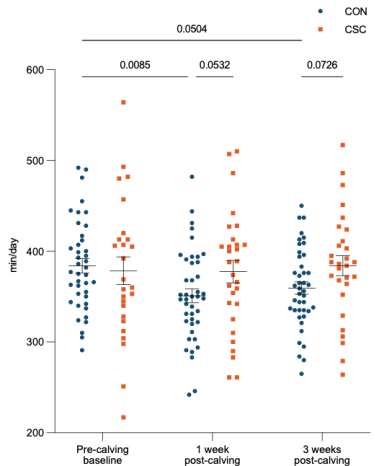
Treatment significantly preserved rumination behaviour through the calving transition (
Figure 1 and
Table 2). Compared to the pre-calving baseline, a statistically significant rumination depression was observed in the control group in the first week, as well as up to 3 weeks after calving (rumination reduced by 33 ± 12 minutes and 25 ± 12 minutes, with p = 0.0084, p = 0.0397, respectively;
Figure 1 and
Table 2). In contrast, no difference was observed in the CSC-treated group (both p > 0.7). The CSC-treated group maintained a daily prolonged rumination of 26 ± 14 minutes and 25 ± 14 minutes respectively, compared with the control group. As a result, the CSC-treated group remained comparable to its pre-calving rumination behaviour (
Figure 1 and
Table 2).
Table 2. Rumination metric of post-calving rumination depression. Rumination behaviour was assessed using a neck-mounted accelerometer collar. The pre-calving rumination baseline presents the rumination behaviour one week before calving, whereas 1 week and 3 weeks post-calving present the mean rumination duration in the respective time period after calving. Values were rounded to the full minute. P-values were calculated using mixed-effect analysis, with n = 42 for the control (CON) and n = 29 for the CSC-treated (CSC) group.
Rumination metric | CON (mean ± SEM) | CSC (mean ± SEM) | Difference between treatment groups (mean ± SE of difference) | p-value |
Pre-calving baseline (min/day) | 384 ± 8 | 379 ± 15 | 5 ± 14 | 0.702 |
1 week post-calving | 351 ±8 | 377 ± 12 | 26 ± 14 | 0.053 |
(difference to pre-calving baseline) | (33 ± 12) | (1 ± 15) | | |
3 weeks post-calving | 359 ± 7 | 384 ±11 | 25 ±14 | 0.073 |
(difference to pre-calving baseline) | (25 ± 12) | (-6 ± 15) | | |
Figure 1. CSC treatment prevents post-calving rumination depression. The rumination behaviour of cows was monitored using neck-mounted accelerometer collars. The mean ± SEM rumination duration of control (CON, blue circles) and CSC-treated (CSC, orange squares) cows were calculated one week before calving (pre-calving baseline), 1 week and 3 weeks after calving. P-values calculated using mixed-effect analysis, with each data point representing an individual cow.
3.4. Milk and Milk Solids Production
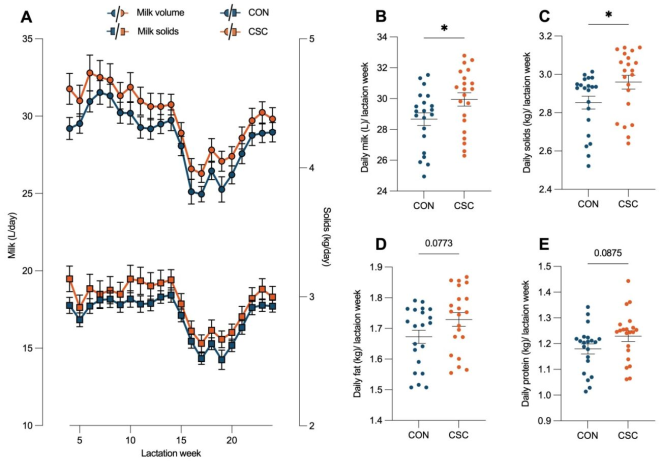
Following CSC treatment, increased milk production, including a significant increase in milk solids, was observed during weeks 4-24 of lactation (
Figure 2A). In detail, CSC-treated cows produced a mean of 30.0 ± 0.4 L of milk daily compared to 28.7 ± 0.4 L in the control group, translating to a 4.5% increase in yield (p = 0.039;
Figure 2B,
Table 3). Simultaneously, a statistically significant increase in total solids (CON 2.85 ± 0.03 kg/day vs CSC 2.96 ± 0.04 kg/day, p = 0.037;
Figure 2C,
Table 3) was observed. This increase was reflected by an increase in 0.06 kg daily milk fat production (CON 1.67 ± 0.02 kg/day vs CSC 1.73 ± 0.02 kg/day, p = 0.077;
Figure 2D,
Table 3), and an increase of 0.05 kg in daily milk protein production (CON 1.18 ± 0.02 kg/day vs CSC 1.23 ± 0.02 kg/day, p = 0.088;
Figure 2D,
Table 3). Over the 24-week analysis period, this corresponded to an average cumulative gain of 188.2 L milk, including 15.69 kg milk solids per treated cow. On average, both groups produced 5.77-5.84% fat and 4.11% protein, despite the CSC-treated group having higher overall production. These results highlight that CSC treatment yields higher milk while maintaining overall milk quality. Furthermore, the beneficial effects of the CSC treatment were sustained throughout early and mid-lactation rather than confined to the immediate post-calving period (
Figure 2A).
Figure 2. CSC positively influences production yield. (A) The milk production (circles) and milk solids (squares) of both groups were measured from week 4 to 24 of lactation. The daily mean ± SEM (B) milk, (C) milk solids, (D) milk fat and (E) milk protein production was calculated per lactation week, with each data point representing a lactation week. Blue symbols represent the control group (CON) and orange symbols the CSC-treated group (CSC), with n = 42 for CON and n = 29 for CSC. P-values were calculated using the Welch’s test with * p < 0.05.
Table 3. Overview of treatment-related increase in milk production in lactation week 4-24. The daily milk volume and milk solids in lactation week 4-24 were calculated based on the weekly reported production data. The respective average increase in production from the CSC-treated (CSC) group compared to the control (CON) group was calculated. P-values were calculated using the Welch’s test, with n = 42 for the CON and n = 29 for CSC group.
Production metric | CON | CSC | p-value |
Milk yield (L/day, mean ± SEM) | 28.7 ± 0.4 | 30.0 ± 0.4 | 0.039 |
Difference to CON (L/day) | | +1.3 | |
% increase | | +4.5% | |
Solids (kg/day, mean ± SEM) | 2.85 ± 0.03 | 2.96 ± 0.04 | 0.037 |
% milk solids | 9.95% | 9.88% | |
Difference to CON (kg/day) | | +0.11 | |
Fat (kg/day, mean ± SEM) | 1.67 ± 0.02 | 1.73 ± 0.02 | 0.077 |
% milk fat | 5.84% | 5.77% | |
Difference to CON (kg/day) | | +0.06 | |
Protein (kg/day, mean ± SEM) | 1.18 ± 0.02 | 1.23 ± 0.02 | 0.088 |
% milk protein | 4.11% | 4.11% | |
Difference to CON (kg/day) | | +0.05 | |
3.5. Reproductive Performance
CSC-treated cows exhibited superior reproductive outcomes. Cows in the treatment group showed their first heat 6 days earlier than control cows (p = 0.089). The first-service conception rate was 26.6% higher (p = 0.015) in the treatment group compared to the control group. Additionally, the CSC-treated group experienced a statistically significant reduction in the number of services per conception and a significant reduction in days to conception of 9 days (
Table 4). Taken together, CSC treatment resulted in a statistically significant increase in fertility.
Table 4. Reproductive outcome is beneficially influenced by CSC treatment. Fertility features, including days to first heat, first-service conception rate, days to conception, number of services per conception, and empty rate, were assessed in the control (CON, n = 41) and CSC-treated group (CSC, n = 29). One cow was excluded due to missing reproduction data. P-values were calculated using the Welch’s test.
Reproductive Outcome | CON | CSC | p-value |
Days to first heat (mean ± SEM) | 29 ± 2 | 23 ± 3 | 0.089 |
Difference to CON (days) | | -6 | |
First-service conception rate (%) | 63.1% (26/41) | 89.7% (26/29) | 0.015 |
Difference to CON (%) | | +26.6% | |
Days to conception (mean ± SEM) | 100 ± 3 | 91 ± 2.5 | 0.034 |
Difference to CON | | -9 | |
Services / conception (mean ± SEM) | 1.5 ± 0.1 | 1.1 ± 0.1 | 0.012 |
Empty rate (%) | 12.2% (5/41) | 3.5% (1/29) | 0.389 |
Difference to CON (%) | | -8.7 | |
4. Discussion
Supplemented cows showed less suppression of post-calving rumination behaviour, increased milk production, and improved reproductive performance compared to untreated controls.
Oral calcium supplementation is typically directed toward herds with a high incidence of clinical milk fever or cows deemed high-risk, with prevention of recumbency as the primary goal. However, SCH is common in pasture-based systems and may negatively affect production and reproductive outcomes even when clinical disease incidence is low.
A meta-analysis of 22 studies evaluating predominantly short-acting calcium boluses found no evidence of effect on metritis, displaced abomasum, ketosis, fertility, or milk yield despite reductions in milk fever and retained placenta
| [23] | Ma ZR, Ma LL, Zhao F, Bo Y. Effects of oral calcium on reproduction and postpartum health in cattle: a meta-analysis and quality assessment. Front Vet Sci 11, 1357640, 2024. https://doi.org/10.3389/fvets.2024.1357640 |
[23]
. Previous studies have noted that calcium thresholds associated with adverse outcomes vary by endpoint, with reproductive and inflammatory effects occurring at higher calcium concentrations than those associated with clinical recumbency
| [6] | Chapinal N, Carson ME, LeBlanc SJ, Leslie KE, Godden S, Capel M, Santos JE, Overton MW, Duffield TF. The association of serum metabolites in the transition period with milk production and early-lactation reproductive performance. J Dairy Sci 95, 1301-9, 2012.
https://doi.org/10.3168/jds.2011-4724 |
| [21] | Leno BM, Neves RC, Louge IM, Curler MD, Thomas MJ, Overton TR, McArt JAA. Differential effects of a single dose of oral calcium based on postpartum plasma calcium concentration in Holstein cows. J Dairy Sci 101, 3285-302, 2018. https://doi.org/10.3168/jds.2017-13164 |
| [24] | Martinez N, Risco CA, Lima FS, Bisinotto RS, Greco LF, Ribeiro ES, Maunsell F, Galvao K, Santos JE. Evaluation of peripartal calcium status, energetic profile, and neutrophil function in dairy cows at low or high risk of developing uterine disease. J Dairy Sci 95, 7158-72, 2012.
https://doi.org/10.3168/jds.2012-5812 |
[6, 21, 24]
. These findings suggest that brief correction of severe hypocalcaemia may not be sufficient to optimise immune or reproductive function across the herd. Lawlor
et al. (2024) further showed that CSC maintained circulating calcium above 2.14 mmol/L for at least 48 hours post-calving
| [17] | Lawlor J, Neville E, Fahey A. Can supplementation with the Cow Start Complete bolus result in elevated blood calcium status in a group of at-risk dairy cows during the first four days of lactation. Animal and Veterinary Sciences 12(6), 154-60, 2024. https://doi.org/10.11648/j.avs.20241206.12 |
[17]
. The more sustained calcium profile achieved with CSC may therefore contribute to the differences in outcomes compared with conventional short-acting calcium boluses.
Emerging work suggests that the duration of hypocalcaemia may be more important than its nadir. Ametaj (2025) proposed that sustained or delayed SCH initiates an inflammatory and metabolic cascade—termed the "calci-inflammatory network"—with downstream effects on hepatic function, immune signalling, and tissue recovery that persist beyond the period of measurable hypocalcaemia
. Similarly, McArt and Neves (2020) demonstrated that SCH persisting at Day 4 post-calving, rather than transient hypocalcaemia in the first 24 hours, predicts reduced milk production, increased disease incidence, and impaired reproductive performance
| [25] | McArt JAA, Neves RC. Association of transient, persistent, or delayed subclinical hypocalcemia with early lactation disease, removal, and milk yield in Holstein cows. J Dairy Sci 103, 690-701, 2020. https://doi.org/10.3168/jds.2019 -17191 |
[25]
. The production improvements observed in the current study align with this framework. The persistence of differences between the groups persisted through week 24—beyond any direct pharmacological effect of supplementation—suggesting that mitigation of sustained or delayed SCH in treated cows may have contributed to the enhanced lactation performance.
CSC-treated cows maintained rumination activity closer to their pre-calving baseline, whereas control cows exhibited a reduction of 33 minutes per day during the first week post-calving. This mirrors earlier published work by Lawlor (2024), who showed that CSC-treated cows recovered rumination in the peri-calving period faster than untreated controls and maintained a higher overall rumination rate (minutes/day) through 14 days post-calving
| [17] | Lawlor J, Neville E, Fahey A. Can supplementation with the Cow Start Complete bolus result in elevated blood calcium status in a group of at-risk dairy cows during the first four days of lactation. Animal and Veterinary Sciences 12(6), 154-60, 2024. https://doi.org/10.11648/j.avs.20241206.12 |
[17]
. Reduced rumination in early lactation has been associated with metabolic stress and hypocalcaemia, reflecting impaired rumen motility mediated by calcium-dependent smooth muscle function
| [8] | Daniel RC. Motility of the rumen and abomasum during hypocalcaemia. Can J Comp Med 47, 276-80, 1983. |
| [11] | Goff JP, Hohman A, Timms LL. Effect of subclinical and clinical hypocalcemia and dietary cation-anion difference on rumination activity in periparturient dairy cows. J Dairy Sci 103, 2591-601, 2020.
https://doi.org/10.3168/jds.2019-17581 |
[8, 11]
. Experimental induction of hypocalcaemia reduces rumen contraction frequency even in the absence of clinical recumbency
| [15] | Jorgensen RJ, Nyengaard NR, Hara S, Enemark JM, Andersen PH. Rumen motility during induced hyper- and hypocalcaemia. Acta Vet Scand 39, 331-8, 1998. |
[15]
. Importantly, in this study, the rumination suppression observed in controls occurred in the absence of ketosis, and in cows with excellent body condition, suggesting that the drop was unlikely the result of negative energy balance. This is consistent with findings by Goff
et al. (2020), who observed that normocalcaemic cows (serum Ca > 2.2 mmol/L) maintain significantly higher rumination activity in the first 48 hours compared to subclinical peers, regardless of subsequent disease status
| [11] | Goff JP, Hohman A, Timms LL. Effect of subclinical and clinical hypocalcemia and dietary cation-anion difference on rumination activity in periparturient dairy cows. J Dairy Sci 103, 2591-601, 2020.
https://doi.org/10.3168/jds.2019-17581 |
[11]
.
CSC-treated cows exhibited earlier return to oestrus, higher first-service conception rate, and fewer services per conception. Mating commenced approximately 12 weeks after the planned start of calving, by which time circulating calcium homeostasis typically normalises. The persistence of these fertility differences suggests that events in the early lactation may have influenced subsequent fertility.
A plausible mechanism involves immune-mediated uterine recovery. Kimura
et al. (2006) demonstrated that intracellular calcium depletion in bovine neutrophils precedes detectable declines in circulating calcium levels, thereby impairing immune activation even before serum hypocalcaemia is evident
. Furthermore, Martinez
et al. (2012) reported that the risk of metritis declines by 22% for every 0.25 mmol/L increase in serum calcium below 2.14 mmol/L
| [24] | Martinez N, Risco CA, Lima FS, Bisinotto RS, Greco LF, Ribeiro ES, Maunsell F, Galvao K, Santos JE. Evaluation of peripartal calcium status, energetic profile, and neutrophil function in dairy cows at low or high risk of developing uterine disease. J Dairy Sci 95, 7158-72, 2012.
https://doi.org/10.3168/jds.2012-5812 |
[24]
. By sustaining higher calcium concentrations during the critical first 48-72 hours, CSC supplementation likely supports neutrophil-mediated uterine clearance needed for timely involution (Lawlor
et al. 2024). Consistent with this, uterine horn diameter at 21 days in milk was 2.6 mm (13%) narrower (n
≥ 20 per group
; padj < 0.10) in CSC-supplemented cows compared with controls in an Irish grazing trial.
These reproductive benefits appear independent of energy balance. Although negative energy balance and ketosis suppress the hypothalamic-pituitary-ovarian axis, calcium status directly affects uterine tone and inflammatory regulation
. In the present study, clinical ketosis was rare (1 case among 71 cows), yet reproductive outcomes were enhanced, suggesting a calcium-mediated rather than metabolic basis for the observed reproductive advantage.
Furthermore, numerous physiological factors have been reported to impact fertility performance in dairy cows, such as; genetics, reproduction program, housing, transition period health and body condition scoring
| [2] | Barletta, R.; Filho, M. M.; Carvalho, P.; Del Valle, T.; Netto, A.; Rennó, F.; Mingoti, R.; Gandra, J.; Mourão, G.; Fricke, P.; et al. Associ ation of changes among body condition score during the transition period with NEFA and BHBA concentrations, milk production, fertility, and health of Holstein cows. Theriogenology 2017, 104, 30–36.
https://doi.org/10.1016/j.theriogenology.2017.07.030 |
| [4] | Carvalho, M.; Peñagaricano, F.; Santos, J.; Devries, T.; McBride, B.; Ribeiro, E. Long-term effects of postpartum clinical disease on milk production, reproduction, and culling of dairy cows. J. Dairy Sci. 2019, 102, 11701–11717.
https://doi.org/10.3168/jds.2019-17025 |
| [5] | Carvalho, P. D.; Souza, A. H.; Amundson, M. C.; Hackbart, K. S.; Fuenzalida, M. J.; Herlihy, M. M.; Ayres, H.; Dresch, A. R.; Vieira, L. M.; Guenther, J. N.; et al. Relationships between fertility and postpartum changes in body condition and body weight in lactating dairy cows. J. Dairy Sci. 2014, 97, 3666–3683. https://doi.org/10.3168/jds.2013-7809 |
| [7] | Consentini, C.;E,. Wiltbank M. C., Sartori, R. Factors That Optimize Reproductive Efficiency in Dairy Herds with an Emphasis on Timed Artificial Insemination Programs. Animals Animals 2021, 11(2), 301;
https://doi.org/10.3390/ani11020301 |
[2, 4, 5, 7]
. Numerous studies under varying management systems and geographies have shown that CSC supplementation consistently reduces levels of postpartum retained placenta (numerical result), uterine infections (P<0.05) and body condition loss in early lactation, when compared to un-supplemented control and cows supplemented with other oral calcium products (P<0.05)
| [18] | Lawlor J, Fahey A, Neville E, Stack A, Mulligan F. On-farm Safety and Efficacy Trial of Cow Start Calcium Bolus. Animal and Veterinary Sciences 7(6), 113-8, 2019.
https://doi.org/10.11648/j.avs.20190706.11 |
| [19] | Lawlor J, Fahey A, Neville E, Stack A, Mulligan F. Effect of Cow Start Calcium Bolus on Metabolic Status and Milk Production in Early Lactation. Animal and Veterinary Sciences 8(6), 124-32, 2020.
https://doi.org/10.11648/j.avs.20200806.12 |
[18, 19]
. The improved uterine health and body condition scores seen in these CSC studies, address a number of the key physiological challenges cows face in terms of enhanced fertility performance. The CSC study cows demonstrated reduced days to conception (P<0.05), fewer serves per conception (P<0.05) and higher pregnancy rates to first (P<0.05) and second service (P<0.05)
1.
These findings question the adequacy of classifying herds as "high-risk" or "low-risk" for calcium supplementation based on clinical milk fever alone. They support a model in which early-lactation calcium sufficiency shapes production and reproductive responses through SCH-mediated mechanisms not captured by clinical disease monitoring. Even in low-risk pasture-based herds, CSC sustained release supplementation appears to stabilise physiological function rather than merely prevent calcium deficiency.
5. Conclusions
In a pasture-based herd managed under OAD milking, in early lactation, CSC supplementation at calving was associated with improved milk volume and milk solids production, reduced early-lactation rumination suppression, and improved reproductive performance. These consistent outcomes in both New Zealand and Irish grazing systems suggest that CSC provides measurable benefits regardless of the herd's baseline metabolic disease risk.
Abbreviations
BCS | Body Condition Score |
CON | Control Group |
CS | Cow Start |
CSC | Cow Start Complete |
DCAD | Dietary Cation-anion Difference |
DMI | Dry Matter Intake |
OAD | Once-a-day Milking |
SCH | Subclinical Hypocalcaemia |
PKE | Palm Kernel Expeller |
PSC | Planned Start of Calving |
TAD | Twice-a-day Milking |
TD | Transition Diet |
Acknowledgments
The authors would like to acknowledge the cooperation and efforts of the herd owner and also the veterinary support provided by Coastal Veterinary Services Ltd (Taranaki, NZ).
Author Contributions
Michael Froger: Conceptualization, Data curation, Methodology, Project administration, Supervision, Writing – original draft, Writing – review & editing
Sarah Stiegeler: Data Curation, Formal Analysis, Investigation, Methodology, Visualization, Writing – review & editing
John Lawlor: Conceptualization, Investigation, Methodology, Supervision, Visualization, Writing – review & editing
Conflicts of Interest
M Froger is employed by Portero Animal Health Ltd, the NZ distributor of the product evaluated in this study. Portero Animal Health Ltd provided the product used in the study. J Lawlor is employed by Anchor Life Science Ltd, the manufacturer of the product used in the study. There are no other conflicts of interest related to this publication.
References
| [1] |
Ametaj BN. The Calci-Inflammatory Network: A Paradigm Shift in Understanding Milk Fever. Dairy 6, 22, 2025.
https://doi.org/10.3390/dairy6030022
|
| [2] |
Barletta, R.; Filho, M. M.; Carvalho, P.; Del Valle, T.; Netto, A.; Rennó, F.; Mingoti, R.; Gandra, J.; Mourão, G.; Fricke, P.; et al. Associ ation of changes among body condition score during the transition period with NEFA and BHBA concentrations, milk production, fertility, and health of Holstein cows. Theriogenology 2017, 104, 30–36.
https://doi.org/10.1016/j.theriogenology.2017.07.030
|
| [3] |
Butler WR. Energy balance relationships with follicular development, ovulation and fertility in postpartum dairy cows. Livestock Production Science 83, 211-8, 2003.
https://doi.org/10.1016/S0301-6226(03)00112-X
|
| [4] |
Carvalho, M.; Peñagaricano, F.; Santos, J.; Devries, T.; McBride, B.; Ribeiro, E. Long-term effects of postpartum clinical disease on milk production, reproduction, and culling of dairy cows. J. Dairy Sci. 2019, 102, 11701–11717.
https://doi.org/10.3168/jds.2019-17025
|
| [5] |
Carvalho, P. D.; Souza, A. H.; Amundson, M. C.; Hackbart, K. S.; Fuenzalida, M. J.; Herlihy, M. M.; Ayres, H.; Dresch, A. R.; Vieira, L. M.; Guenther, J. N.; et al. Relationships between fertility and postpartum changes in body condition and body weight in lactating dairy cows. J. Dairy Sci. 2014, 97, 3666–3683.
https://doi.org/10.3168/jds.2013-7809
|
| [6] |
Chapinal N, Carson ME, LeBlanc SJ, Leslie KE, Godden S, Capel M, Santos JE, Overton MW, Duffield TF. The association of serum metabolites in the transition period with milk production and early-lactation reproductive performance. J Dairy Sci 95, 1301-9, 2012.
https://doi.org/10.3168/jds.2011-4724
|
| [7] |
Consentini, C.;E,. Wiltbank M. C., Sartori, R. Factors That Optimize Reproductive Efficiency in Dairy Herds with an Emphasis on Timed Artificial Insemination Programs. Animals Animals 2021, 11(2), 301;
https://doi.org/10.3390/ani11020301
|
| [8] |
Daniel RC. Motility of the rumen and abomasum during hypocalcaemia. Can J Comp Med 47, 276-80, 1983.
|
| [9] |
Goff JP. The monitoring, prevention, and treatment of milk fever and subclinical hypocalcemia in dairy cows. Vet J 176, 50-7, 2008.
https://doi.org/10.1016/j.tvjl.2007.12.020
|
| [10] |
Goff JP, Horst RL. Physiological changes at parturition and their relationship to metabolic disorders. J Dairy Sci 80, 1260-8, 1997.
|
| [11] |
Goff JP, Hohman A, Timms LL. Effect of subclinical and clinical hypocalcemia and dietary cation-anion difference on rumination activity in periparturient dairy cows. J Dairy Sci 103, 2591-601, 2020.
https://doi.org/10.3168/jds.2019-17581
|
| [12] |
Hayirli A, Grummer RR, Nordheim EV, Crump PM. Animal and dietary factors affecting feed intake during the prefresh transition period in Holsteins. J Dairy Sci 85, 3430-43, 2002.
https://doi.org/10.3168/jds.S0022-0302(02)74431-7
|
| [13] |
Hoffmann da Silva J, Hoefle CA, Cupper Vieira C, Kreutz LC, Cabrera Dalto AG, Dias Goncalves PB, Tomazele Rovani M, Ferreira R. How can blood calcium concentration and oral supplementation affect uterine health in dairy cows? Theriogenology 244, 117496, 2025.
https://doi.org/10.1016/j.theriogenology.2025.117496
|
| [14] |
Houe H, Ostergaard S, Thilsing-Hansen T, Jorgensen RJ, Larsen T, Sorensen JT, Agger JF, Blom JY. Milk fever and subclinical hypocalcaemia--an evaluation of parameters on incidence risk, diagnosis, risk factors and biological effects as input for a decision support system for disease control. Acta Vet Scand 42, 1-29, 2001.
|
| [15] |
Jorgensen RJ, Nyengaard NR, Hara S, Enemark JM, Andersen PH. Rumen motility during induced hyper- and hypocalcaemia. Acta Vet Scand 39, 331-8, 1998.
|
| [16] |
Kimura K, Reinhardt TA, Goff JP. Parturition and hypocalcemia blunts calcium signals in immune cells of dairy cattle. J Dairy Sci 89, 2588-95, 2006.
https://doi.org/10.3168/jds.S0022-0302(06)72335-9
|
| [17] |
Lawlor J, Neville E, Fahey A. Can supplementation with the Cow Start Complete bolus result in elevated blood calcium status in a group of at-risk dairy cows during the first four days of lactation. Animal and Veterinary Sciences 12(6), 154-60, 2024.
https://doi.org/10.11648/j.avs.20241206.12
|
| [18] |
Lawlor J, Fahey A, Neville E, Stack A, Mulligan F. On-farm Safety and Efficacy Trial of Cow Start Calcium Bolus. Animal and Veterinary Sciences 7(6), 113-8, 2019.
https://doi.org/10.11648/j.avs.20190706.11
|
| [19] |
Lawlor J, Fahey A, Neville E, Stack A, Mulligan F. Effect of Cow Start Calcium Bolus on Metabolic Status and Milk Production in Early Lactation. Animal and Veterinary Sciences 8(6), 124-32, 2020.
https://doi.org/10.11648/j.avs.20200806.12
|
| [20] |
Lawlor J, Reardon R, O’Sé C, Neville E, Fahey A. Effect of Cow Start bolus supplementation on early lactation health and performance indicators in a group of older, at-risk dairy cows. Animal and Veterinary Sciences 9(5), 134-40, 2021.
https://doi.org/10.11648/j.avs.20210905.12
|
| [21] |
Leno BM, Neves RC, Louge IM, Curler MD, Thomas MJ, Overton TR, McArt JAA. Differential effects of a single dose of oral calcium based on postpartum plasma calcium concentration in Holstein cows. J Dairy Sci 101, 3285-302, 2018.
https://doi.org/10.3168/jds.2017-13164
|
| [22] |
Liang D, Arnold LM, Stowe CJ, Harmon RJ, Bewley JM. Estimating US dairy clinical disease costs with a stochastic simulation model. J Dairy Sci 100, 1472-86, 2017.
https://doi.org/10.3168/jds.2016-11565
|
| [23] |
Ma ZR, Ma LL, Zhao F, Bo Y. Effects of oral calcium on reproduction and postpartum health in cattle: a meta-analysis and quality assessment. Front Vet Sci 11, 1357640, 2024.
https://doi.org/10.3389/fvets.2024.1357640
|
| [24] |
Martinez N, Risco CA, Lima FS, Bisinotto RS, Greco LF, Ribeiro ES, Maunsell F, Galvao K, Santos JE. Evaluation of peripartal calcium status, energetic profile, and neutrophil function in dairy cows at low or high risk of developing uterine disease. J Dairy Sci 95, 7158-72, 2012.
https://doi.org/10.3168/jds.2012-5812
|
| [25] |
McArt JAA, Neves RC. Association of transient, persistent, or delayed subclinical hypocalcemia with early lactation disease, removal, and milk yield in Holstein cows. J Dairy Sci 103, 690-701, 2020.
https://doi.org/10.3168/jds.2019
-17191
|
| [26] |
Neves RC, Leno BM, Bach KD, McArt JAA. Epidemiology of subclinical hypocalcemia in early-lactation Holstein dairy cows: The temporal associations of plasma calcium concentration in the first 4 days in milk with disease and milk production. J Dairy Sci 101, 9321-31, 2018.
https://doi.org/10.3168/jds.2018-14587
|
| [27] |
Oetzel GR. Oral calcium supplementation in peripartum dairy cows. Vet Clin North Am Food Anim Pract 29, 447-55, 2013.
|
| [28] |
Reinhardt TA, Lippolis JD, McCluskey BJ, Goff JP, Horst RL. Prevalence of subclinical hypocalcemia in dairy herds. Vet J 188, 122-4, 2011.
https://doi.org/10.1016/j.tvjl.2010.03.025
|
| [29] |
Roberts KI, McDougall S. Risk factors for subclinical hypocalcaemia, and associations between subclinical hypocalcaemia and reproductive performance, in pasture-based dairy herds in New Zealand. N Z Vet J 67, 12-9, 2019.
https://doi.org/10.1080/00480169.2018.1527732
|
| [30] |
Stelwagen K, Phyn CV, Davis SR, Guinard-Flament J, Pomies D, Roche JR, Kay JK. Invited review: reduced milking frequency: milk production and management implications. J Dairy Sci 96, 3401-13, 2013.
https://doi.org/10.3168/jds.2012-6074
|
Cite This Article
-
APA Style
Froger, M., Stiegeler, S., Lawlor, J. (2026). Effect of a Sustained-release Bolus on Milk Production, Rumination and Reproduction in Multiparous Dairy Cows Classified at Low Milk Fever Risk. Animal and Veterinary Sciences, 14(3), 51-60. https://doi.org/10.11648/j.avs.20261403.12
 Copy
|
Copy
|
 Download
ACS Style
Froger, M.; Stiegeler, S.; Lawlor, J. Effect of a Sustained-release Bolus on Milk Production, Rumination and Reproduction in Multiparous Dairy Cows Classified at Low Milk Fever Risk. Anim. Vet. Sci. 2026, 14(3), 51-60. doi: 10.11648/j.avs.20261403.12
Copy
|
Download
AMA Style
Froger M, Stiegeler S, Lawlor J. Effect of a Sustained-release Bolus on Milk Production, Rumination and Reproduction in Multiparous Dairy Cows Classified at Low Milk Fever Risk. Anim Vet Sci. 2026;14(3):51-60. doi: 10.11648/j.avs.20261403.12
Copy
|
Download
-
@article{10.11648/j.avs.20261403.12,
  author = {Michael Froger and Sarah Stiegeler and John Lawlor},
  title = {Effect of a Sustained-release Bolus on Milk Production, Rumination and Reproduction in Multiparous Dairy Cows Classified at Low Milk Fever Risk},
  journal = {Animal and Veterinary Sciences},
  volume = {14},
  number = {3},
  pages = {51-60},
  doi = {10.11648/j.avs.20261403.12},
  url = {https://doi.org/10.11648/j.avs.20261403.12},
  eprint = {https://article.sciencepublishinggroup.com/pdf/10.11648.j.avs.20261403.12},
  abstract = {The aim of this study was to determine whether the positive transition health, rumination, production, and reproductive responses to Cow Start Complete (CSC) supplementation seen in high milk fever risk Irish and UK studies, extend to multiparous dairy cows managed under low milk fever risk conditions in a NZ pasture-based system using once-a-day (OAD) milking during early lactation. Seventy-one multiparous crossbred dairy cows (3rd – 5th Lactation; 29 CSC-treated, 42 controls) received either 2 x CSC sustained-release boluses at calving or no supplementation. Outcomes observed included transition health performance, rumination behaviour, milk volume and milk solids production (weeks 4–24), and reproductive performance. During the first week after calving, daily rumination levels dropped more in the control group than the treatment group (control – 33 mins/day, p = 0.009 vs treatment – 1 min/day, p = 0.947). In terms of milk production, across weeks 4-24 in lactation, the CSC-treated cows produced 1.3 L more milk per day (+4.5%, p = 0.039) and 0.11 kg more milk solids per day (+3.86%, p = 0.037). Reproductive performance improved in CSC-treated cows when compared to the control cows, higher first-service conception rate (89.7% vs 63.1%, p = 0.015), fewer services per conception (1.1 vs 1.5, p = 0.012) and 9 fewer days to conception (p = 0.034). In a pasture-based herd managed under early lactation OAD milking, CSC supplementation at calving was associated with improved milk volume and milk solids production, reduced early-lactation rumination suppression, and improved reproductive performance. These findings indicate that the CSC sustained-release bolus may confer benefits beyond traditional high-risk hypocalcaemia populations.},
 year = {2026}
}
Copy
|
Download
-
TY  - JOUR
T1  - Effect of a Sustained-release Bolus on Milk Production, Rumination and Reproduction in Multiparous Dairy Cows Classified at Low Milk Fever Risk
AU  - Michael Froger
AU  - Sarah Stiegeler
AU  - John Lawlor
Y1  - 2026/05/21
PY  - 2026
N1  - https://doi.org/10.11648/j.avs.20261403.12
DO  - 10.11648/j.avs.20261403.12
T2  - Animal and Veterinary Sciences
JF  - Animal and Veterinary Sciences
JO  - Animal and Veterinary Sciences
SP  - 51
EP  - 60
PB  - Science Publishing Group
SN  - 2328-5850
UR  - https://doi.org/10.11648/j.avs.20261403.12
AB  - The aim of this study was to determine whether the positive transition health, rumination, production, and reproductive responses to Cow Start Complete (CSC) supplementation seen in high milk fever risk Irish and UK studies, extend to multiparous dairy cows managed under low milk fever risk conditions in a NZ pasture-based system using once-a-day (OAD) milking during early lactation. Seventy-one multiparous crossbred dairy cows (3rd – 5th Lactation; 29 CSC-treated, 42 controls) received either 2 x CSC sustained-release boluses at calving or no supplementation. Outcomes observed included transition health performance, rumination behaviour, milk volume and milk solids production (weeks 4–24), and reproductive performance. During the first week after calving, daily rumination levels dropped more in the control group than the treatment group (control – 33 mins/day, p = 0.009 vs treatment – 1 min/day, p = 0.947). In terms of milk production, across weeks 4-24 in lactation, the CSC-treated cows produced 1.3 L more milk per day (+4.5%, p = 0.039) and 0.11 kg more milk solids per day (+3.86%, p = 0.037). Reproductive performance improved in CSC-treated cows when compared to the control cows, higher first-service conception rate (89.7% vs 63.1%, p = 0.015), fewer services per conception (1.1 vs 1.5, p = 0.012) and 9 fewer days to conception (p = 0.034). In a pasture-based herd managed under early lactation OAD milking, CSC supplementation at calving was associated with improved milk volume and milk solids production, reduced early-lactation rumination suppression, and improved reproductive performance. These findings indicate that the CSC sustained-release bolus may confer benefits beyond traditional high-risk hypocalcaemia populations.
VL  - 14
IS  - 3
ER  -
Copy
|
Download





 Share This Article
 Twitter
 Linked In
 Facebook